
What is an Ooze?
Flexible monsters that don’t fit anywhere

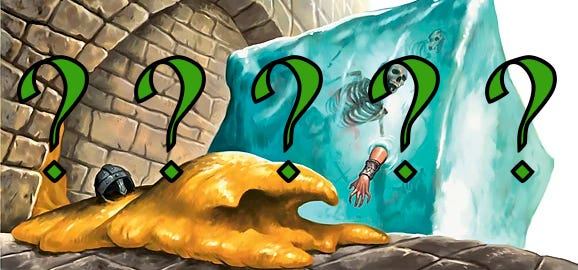
In my last post about physical damage types I mentioned that I’d elaborate on oozes a bit. They’re both so physically unique and so common that I feel they deserve their own niche in the damage-resistance venn diagram. But at the same time they also seem like they could fit anywhere. So in this post I’m going to run through every possibility and see where it leads us.
Oozes Resist Piercing, Bludgeoning, Slashing
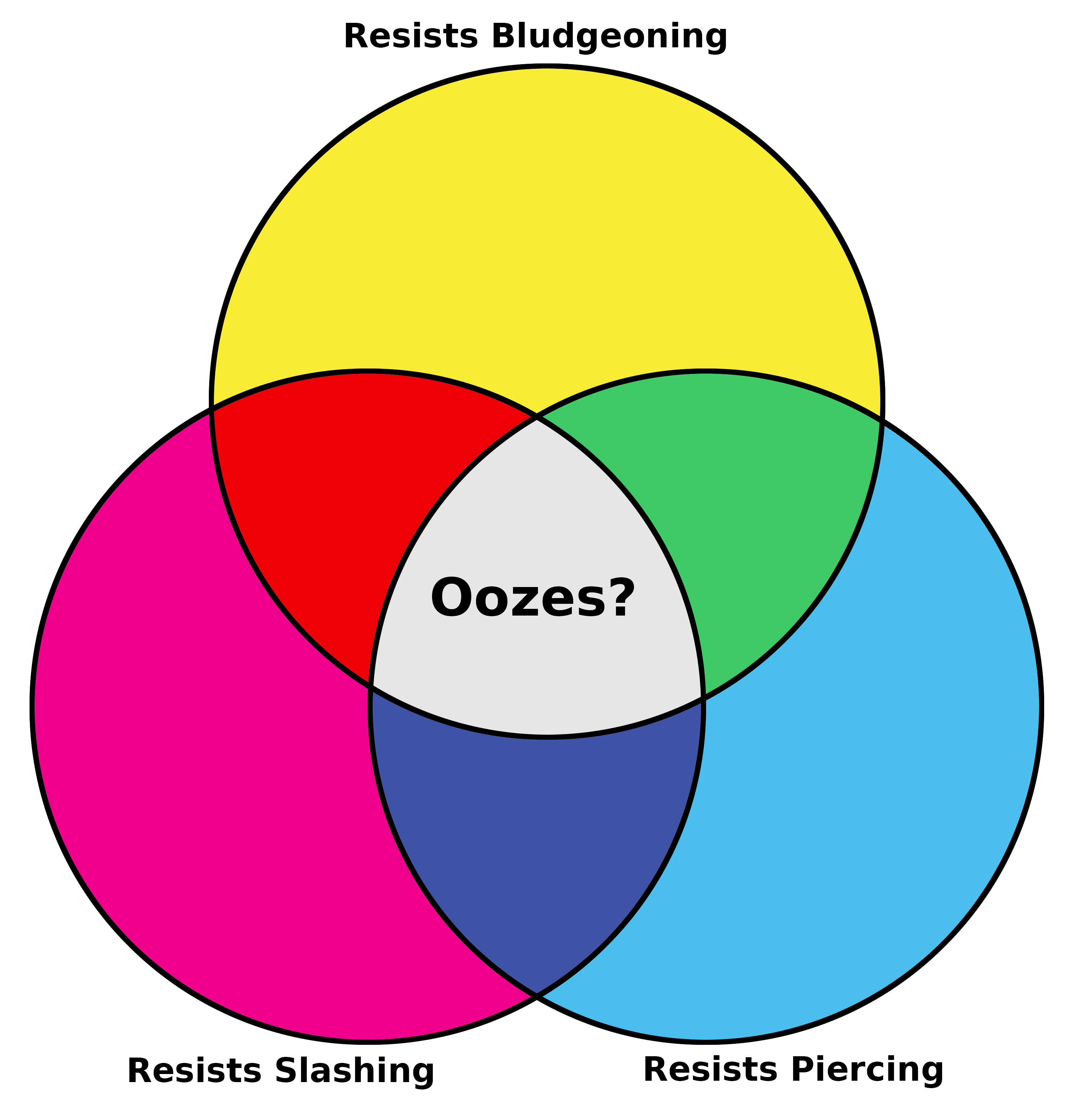
Your instincts might initially pull you to giving oozes full physical damage resistance, or even full immunity, mine do too. This is after all part of what makes an ooze so terrifying; There’s nothing solid to cut or break. There’s no part that won’t meld back into the fold.
Indeed, outside of D&D the archetypal ooze, as seen in The Blob, has to be frozen to death. [Speaking of which, the titular blob is also unaffected by electrocution, which might be the origin of certain oozes immunity to lightning damage]. Killing it with fire also seems like an appropriate go-to for something like an ooze.
So while I wouldn’t begrudge anyone who puts their oozes here and calls it a day, this is a very crowded niche. We already have every kind of swarm here, not to mention all the ghosts and miscellaneous monster 5.5e designers are cramming in. I’d like to give oozes a section of their own and in the process maybe learn a little about them.
Oozes Resist Bludgeoning
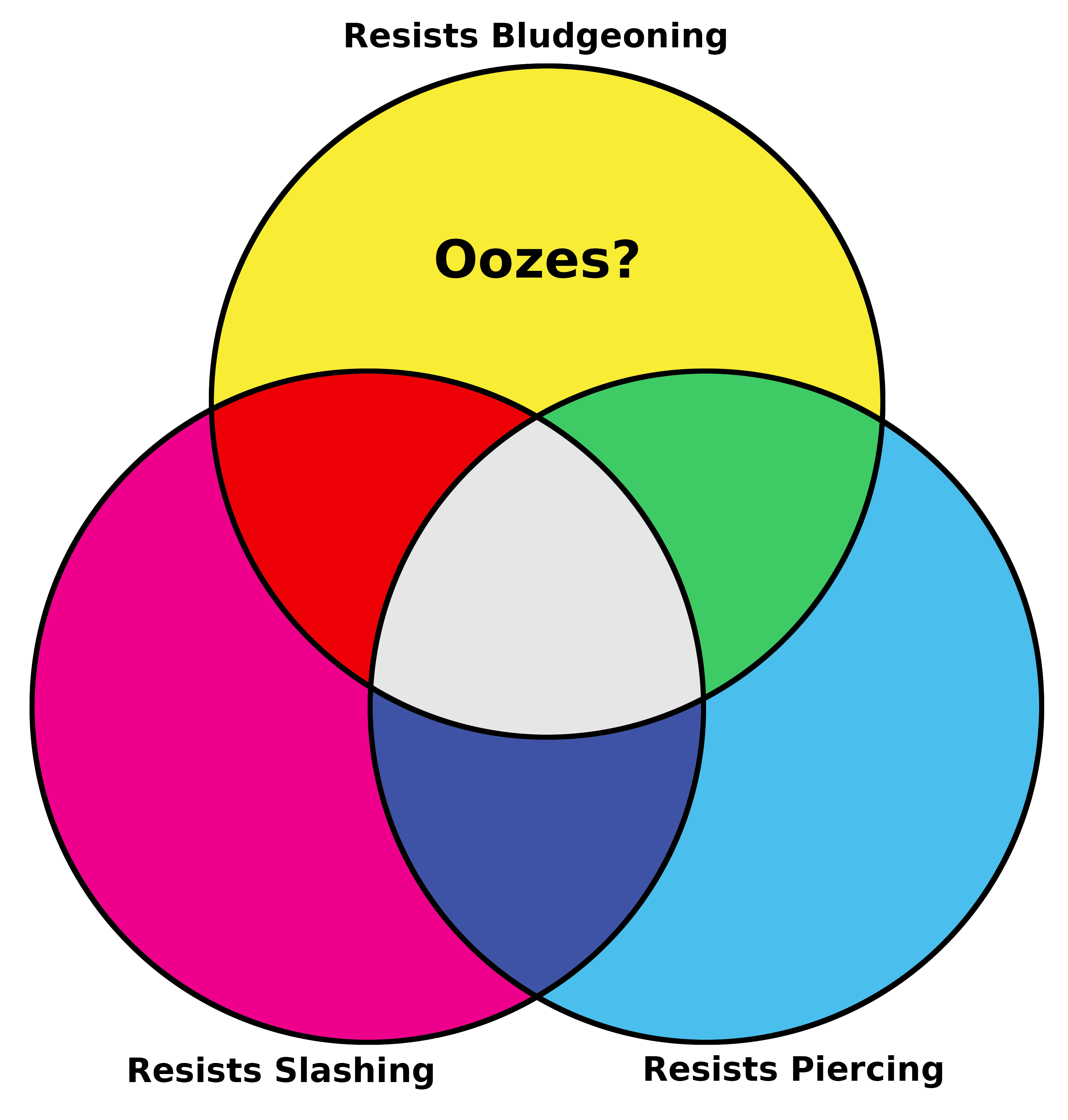
Before I started digging into damage resistances, this is where I initially wanted to put oozes, bludgeoning damage seemed like it had a lot going for it, what with all the skeletons running about, and I felt it needed a core monster to resist it. I still do honestly. So what if oozes were a sort of non-newtonian fluid like this one:
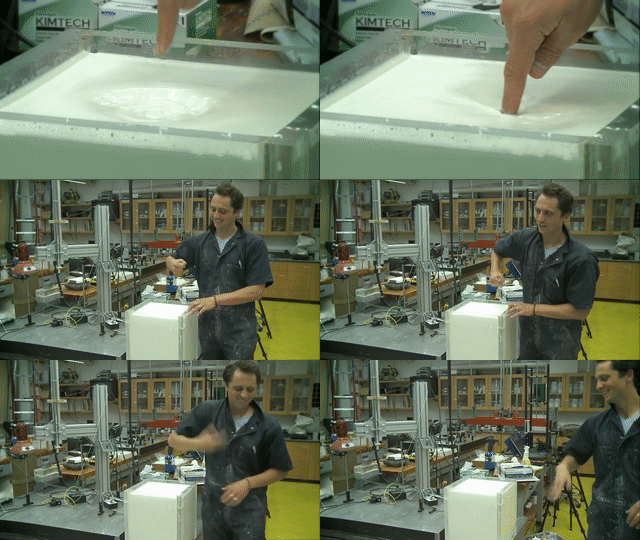
One that hardens in response to blunt trauma. A smooth sword cut or a sharp arrow could force its way through but a hammer just gets bogged down in resistance. Or, even more delightfully, what if the ooze took on a rubbery composure and sent the hammer flying right back at your face.
Oozes Resist Slashing
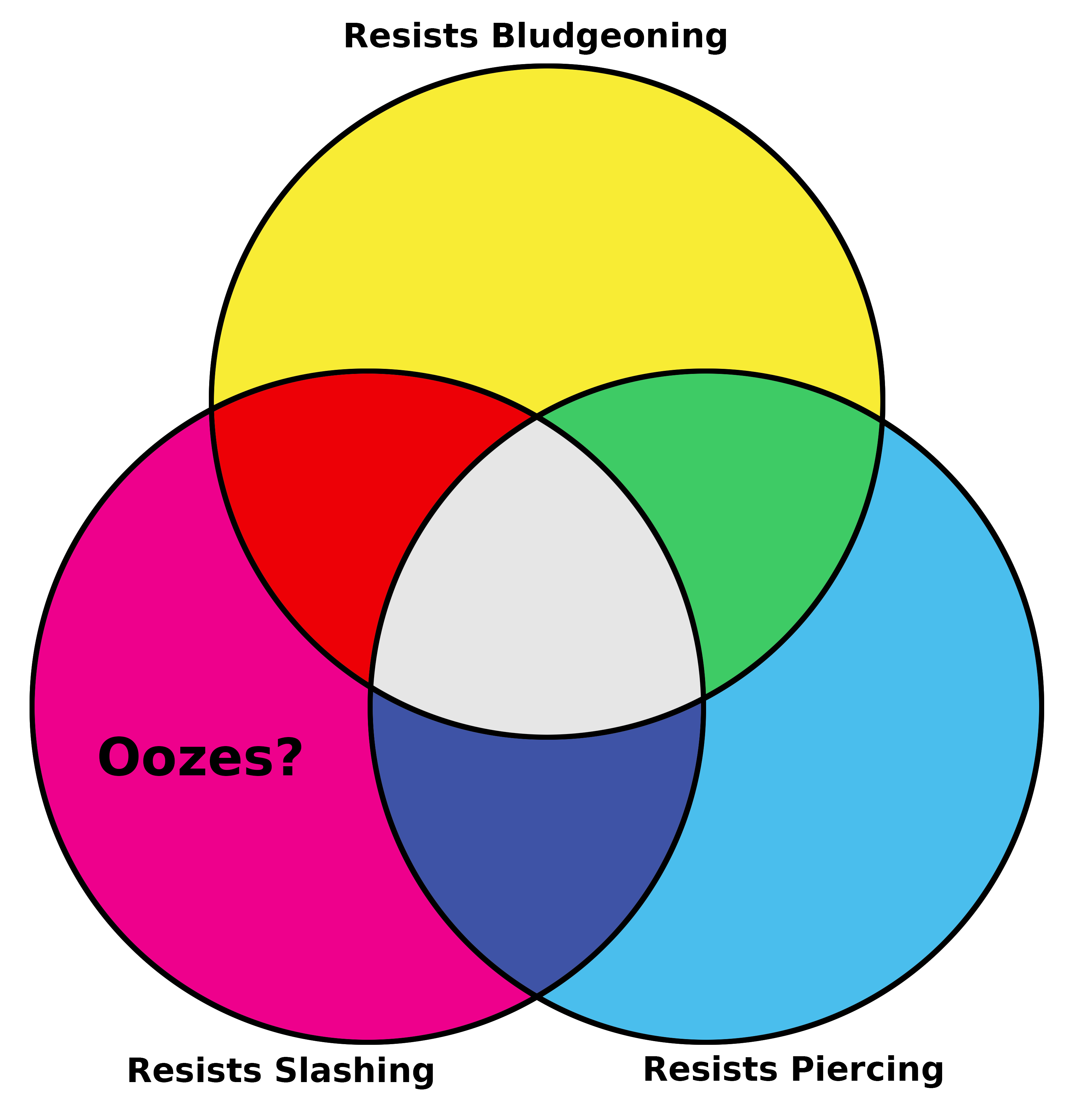
This is the traditional domain of at least two oozes, the Black Pudding and Ochre Jelly, who take the opportunity to split into two oozes. This also happens when they receive lightning damage for reasons I’ve yet to divine.
It’s also not entirely clear why they split. Though I have my theories. My guess is that this is a sort of reproductive behavior. The ooze reproduces via division but it’s sticky outer coating makes that difficult. So the ooze seeks out something to help its separation. The two newly separated oozes then seek out nutrition to regain all their lost body mass. A swashbuckling adventurer can serve as both.
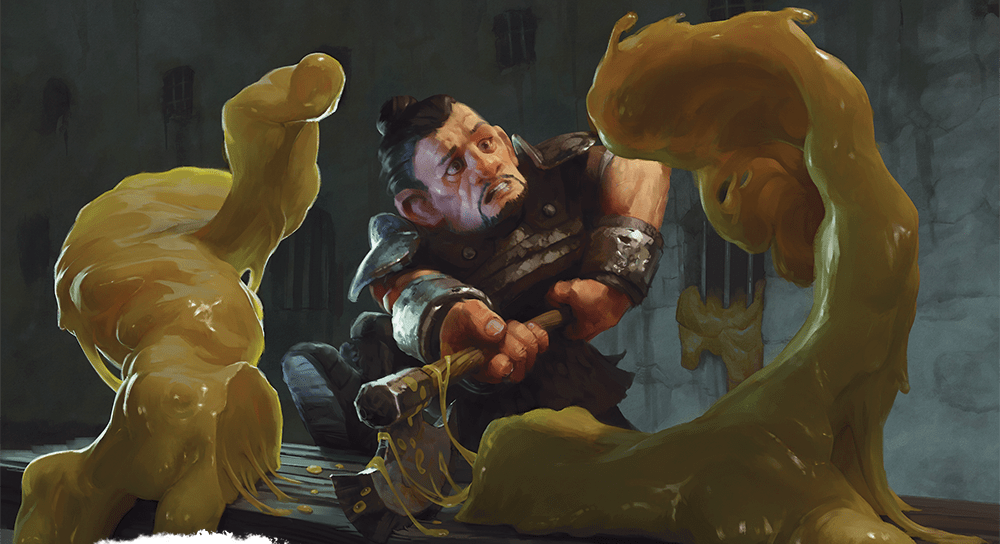
On the face of it, splitting is a kind of fun mechanic, although in my opinion it would be put to better use on a smarter monster. Oozes aren’t doing anything exciting with their new sibling, they’ll just continue trying to eat you. Imagine the shenanigans a goblin that splits in two could get up to.
Here’s another way of imagining it without the splitting: think of oozes as more of a self-repairing jelly. And all their little nerve-connections have to be disrupted to stop its bodily functions. A sword cut is the simplest type of damage to repair, things are severed but not displaced or mangled. In fact, counterintuitively, the sharper your sword and the cleaner you cut, the less damage you do to the ooze.
Oozes Resist Piercing
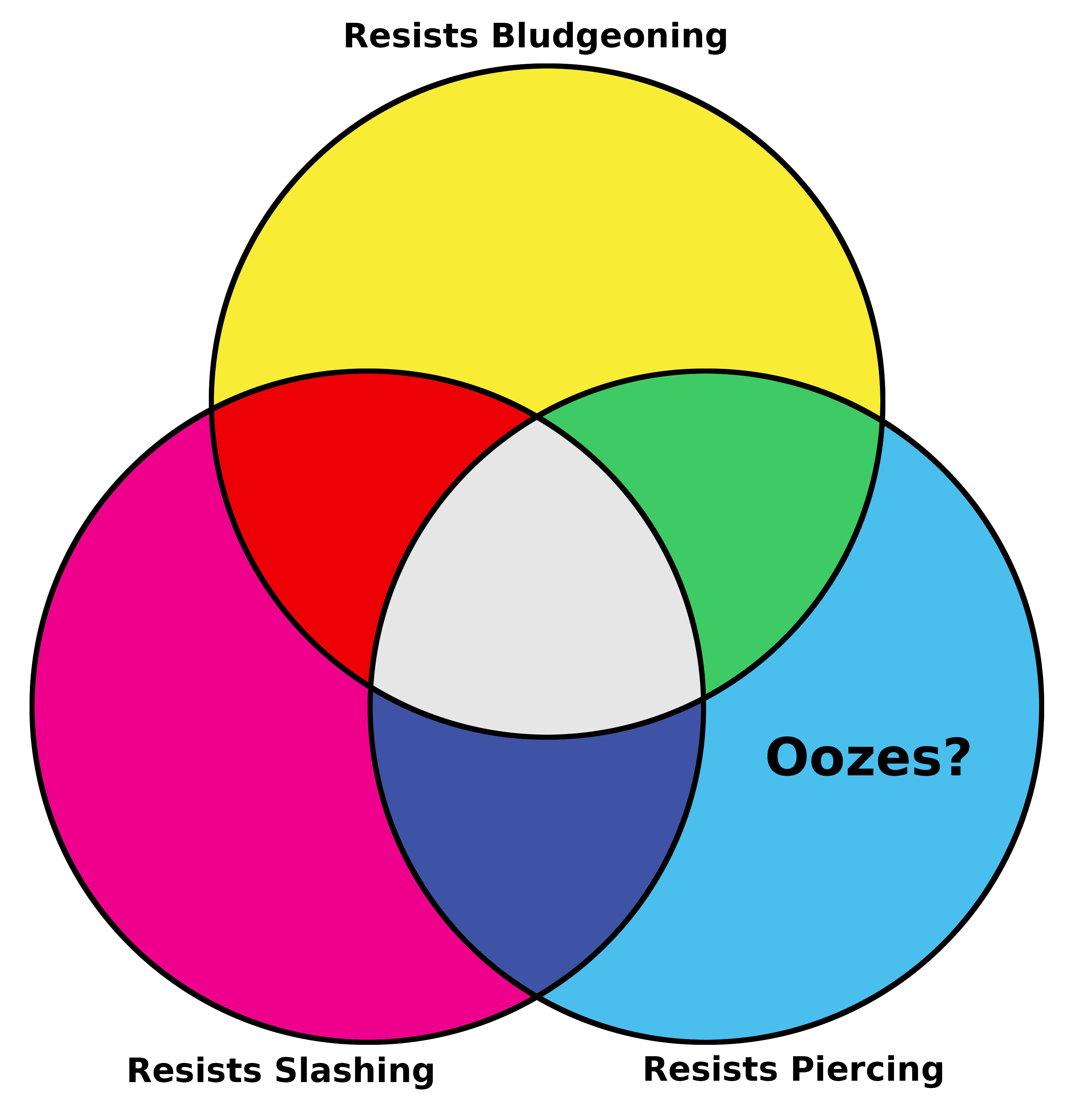
In my initial post on melee damage types I settled on giving fungal creatures resistance to piercing damage since their decentralised bodies lacked a singular weak point which honestly could apply even more so to oozes if we imagine them as more of a colonial organism lacking a centralised brain.
Oozes are Weak to Bludgeoning
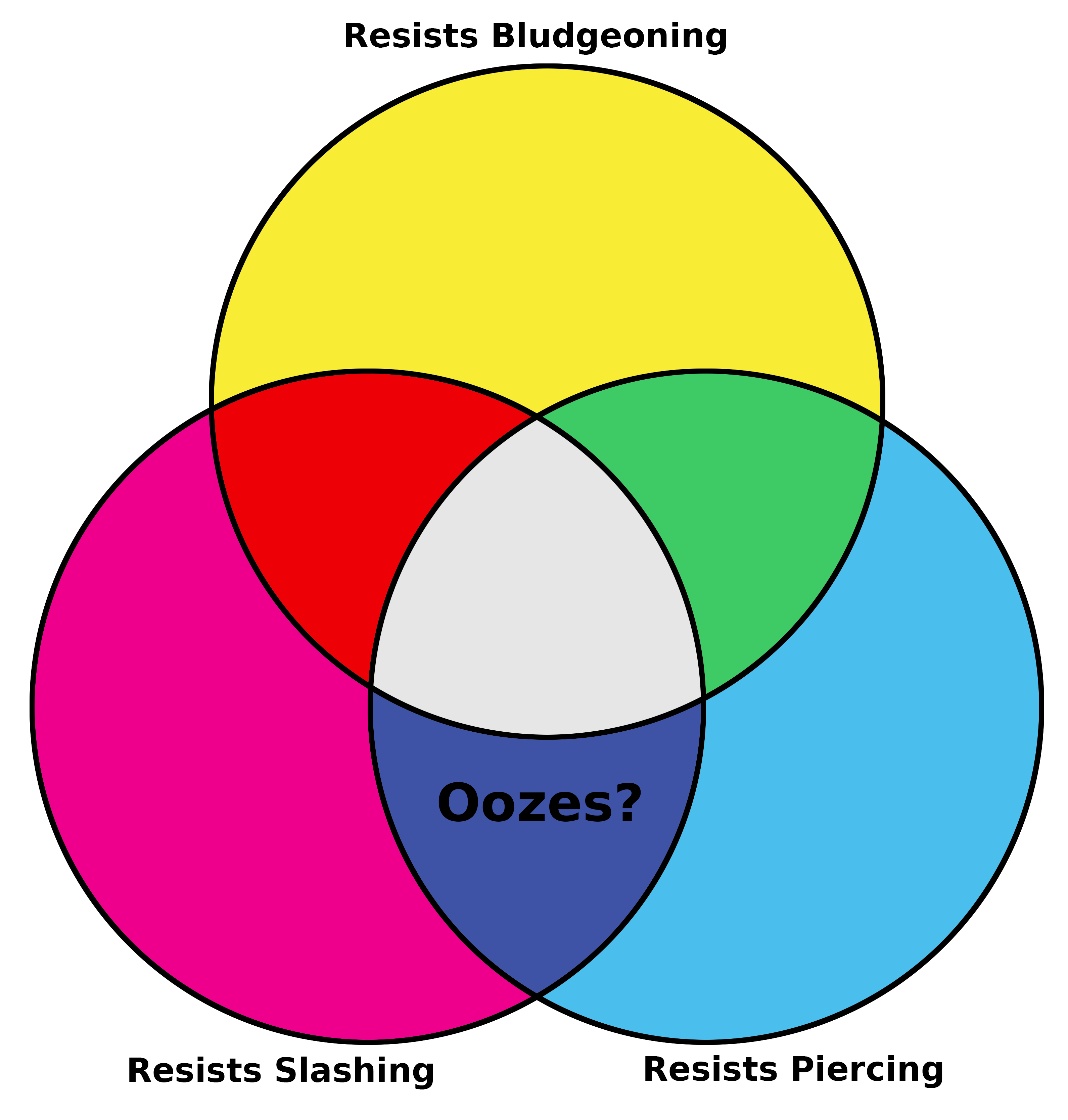
Now what if oozes could self-repair but couldn’t reconnect with their parts once they’ve been separated. Maybe each part immediately becomes independent and treats the other as a foreign body, maybe even going so far as to fight them. Or maybe once they’ve been cut down enough they lose their coherence and go back to being a sessile slime mold again.
If this is how we defeat a ooze then spears would be a suboptimal weapon, swords might work if you used the flat end, but bludgeoning weapons would be best for smashing away big chucks at a time. (Though honestly the perfect weapon would be more like a shovel or big spoon. Max damage for anyone who thinks to bring one of those to a fight.)
Oozes are Weak to Slashing
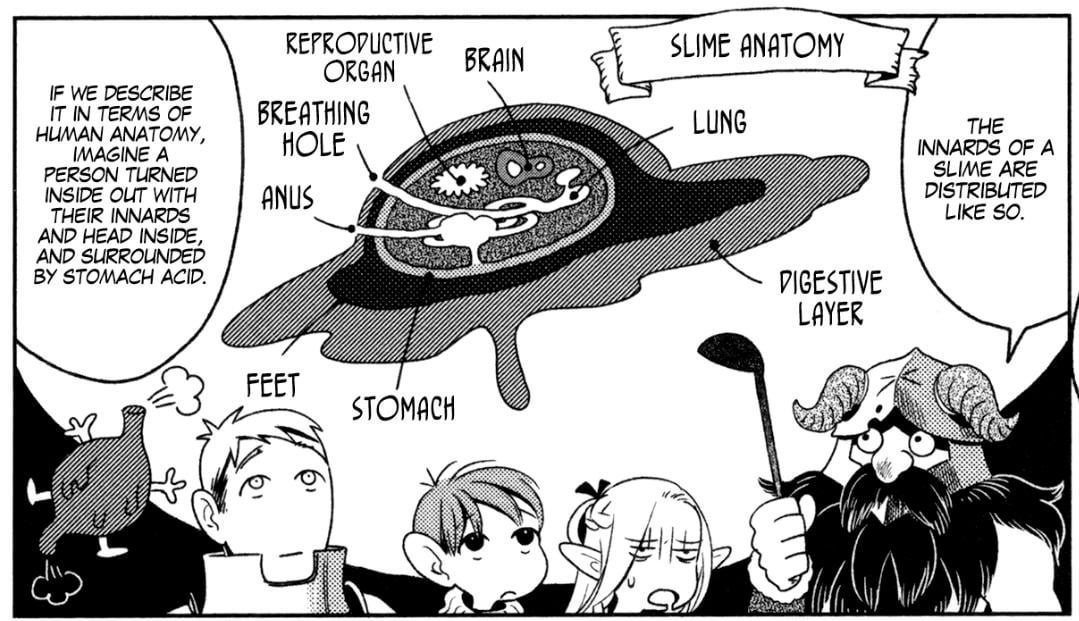
What if instead we imagined oozes as big monocellular organisms held together with a skin like a big slimy balloon. Blunt blows tend to get absorbed or slipped around, while little holes can be sealed off and repaired. The best way to kill is by tearing a big rip through it with a sword and letting its guts spill out.
Oozes are Weak to Piercing
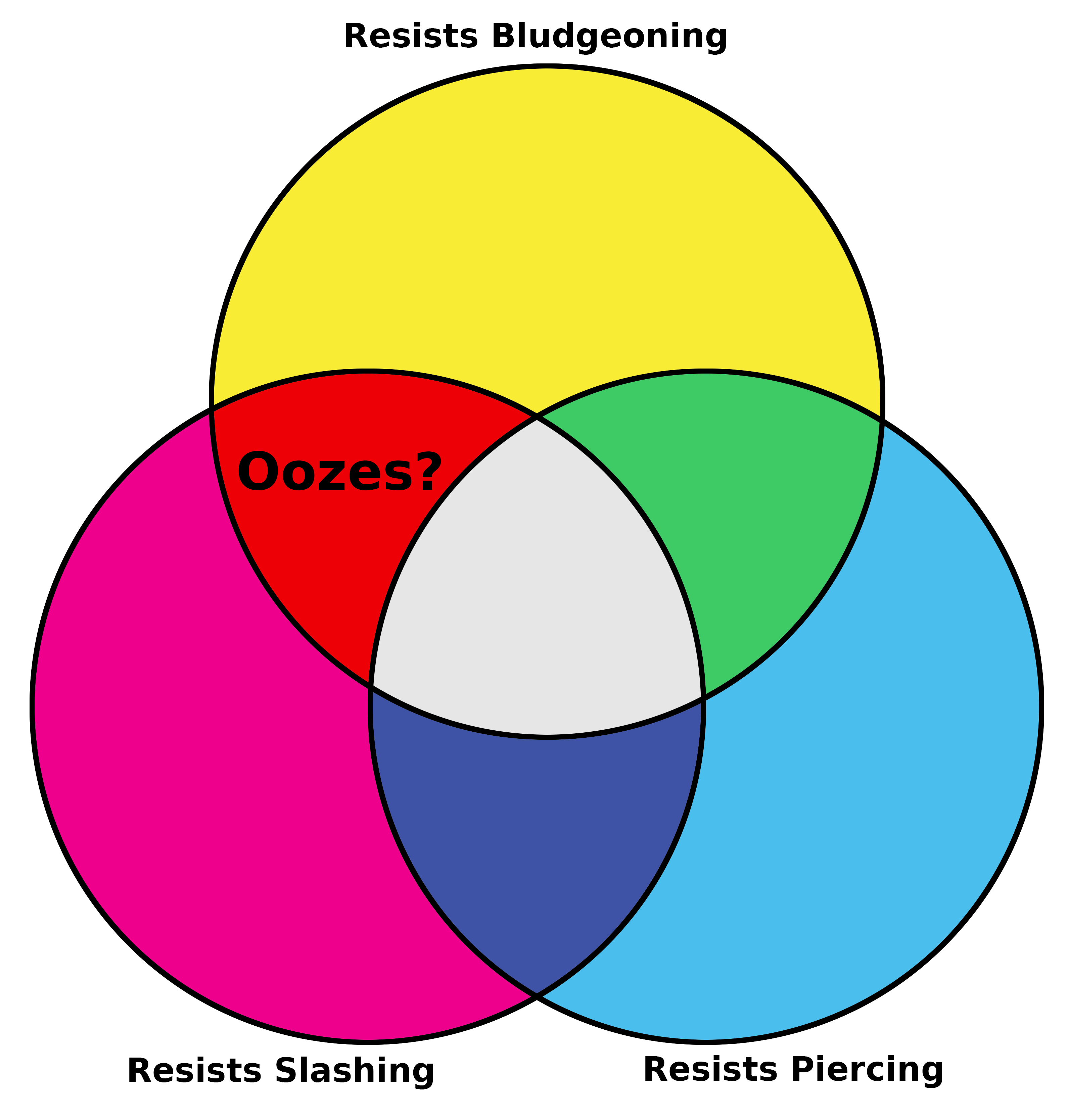
Finally we come to this. What if oozes are more like a sticky tar? Something that traps its prey just by touching them and being difficult to remove. There’s an internal digestive system, yes, but you’ll only see it once you’ve been smothered to death.
Your blunt weapons and swords have too much surface area. They give the ooze something to latch on to and slow them down before they penetrate deep. What you want is a weapon with the least amount of surface area possible and ideally a long handle to stop yourself from getting pulled in. In other words, a nice long spear.
If this is the ooze interpretation that speaks to you, some special rules for oozes trapping and engulfing weapons actually sounds like a much more fun way to run this.
What is an Ooze?
You know, now that we’ve explored all our options, I don’t feel like we’ve actually come any closer to understanding what an ooze is or what they feel like. I decided to dive deeper into D&D lore for answers and found out oozes don’t exist.
Let me explain:
There are only fifteen oozes in all the main 5e books combined; Really only ten if you don’t count variants like oblexes of different sizes and the psychic grey ooze. There are also a few edge cases.
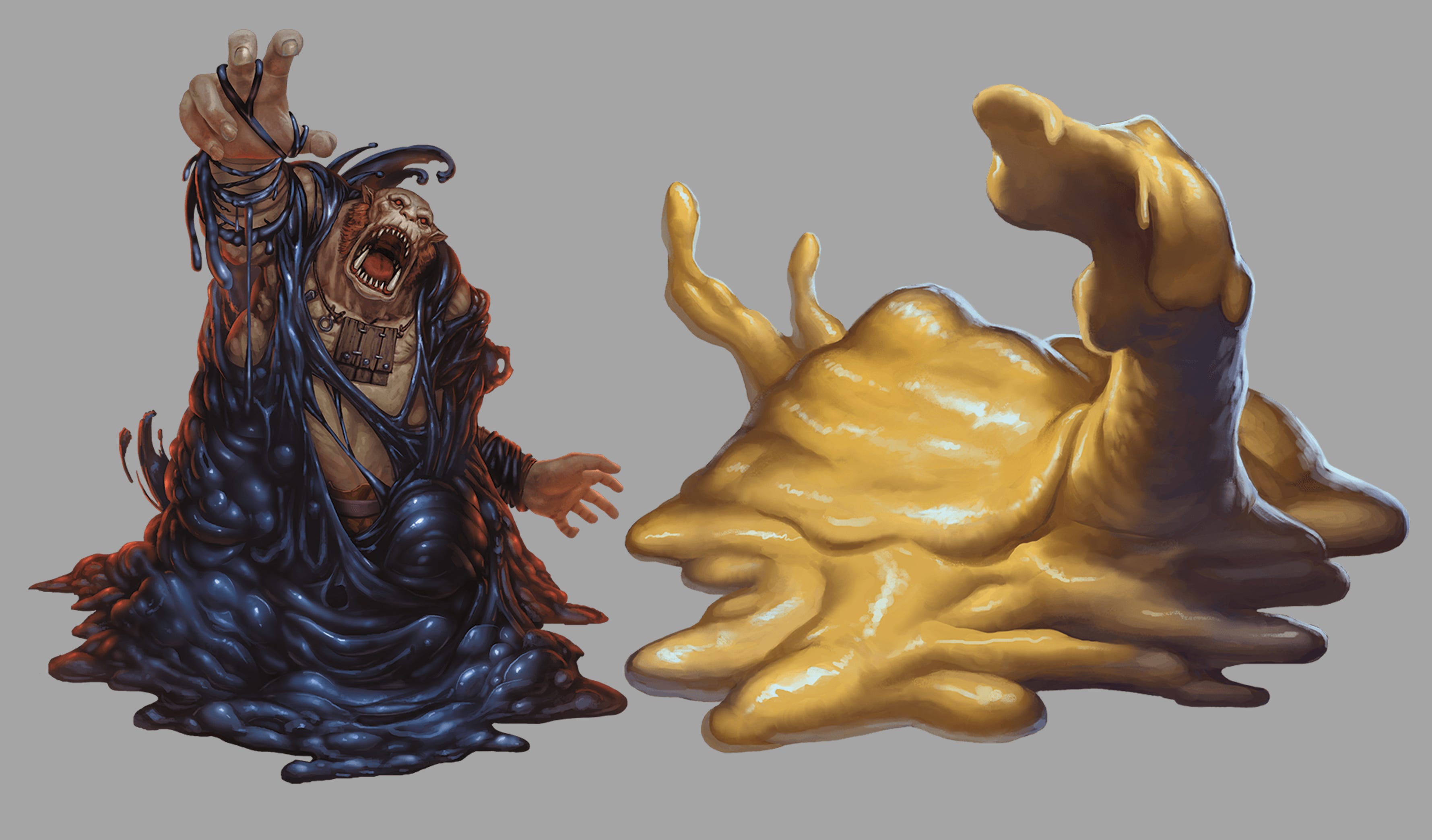
Black Puddings and Ochre Jellies appear to have the most in common and might form the basis for an archetypical ooze. They’re both immune to lightning and slashing and split themselves upon receiving any damage of those typese. But, the 2025 MM describes Ochre Jellies as “giant, yellow-brown amoebas” whereas the Black Pudding is described as a “shapeless masses of predatory cells”, so maybe these things are totally different organisms that convergently evolved a similar adaption to being sawn in half or electrocuted.
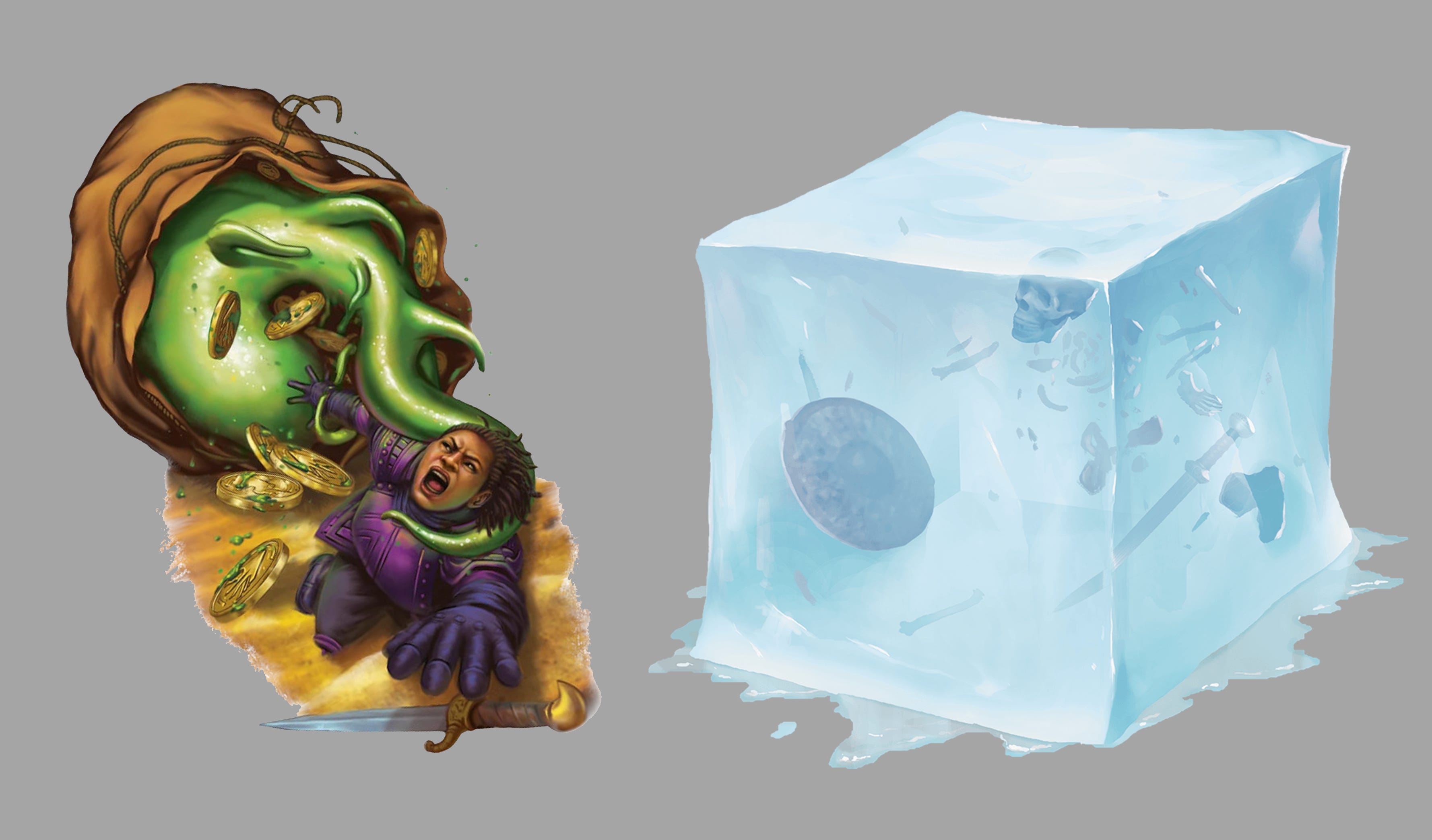
Bag Jellies and Gelatinous Cubes each diverge a bit from the typical ooze-consistency. Whatever way Bag Jellies are built lets them resist bludgeoning damage and Gelatinous Cubes are, as the name implies, not the typical formless puddle. There’s very little information about what gives them this special physical makeup. How does being swallowed by a Gelatinous Cube feel compared to being swallowed by an Ochre Jelly? Be descriptive.
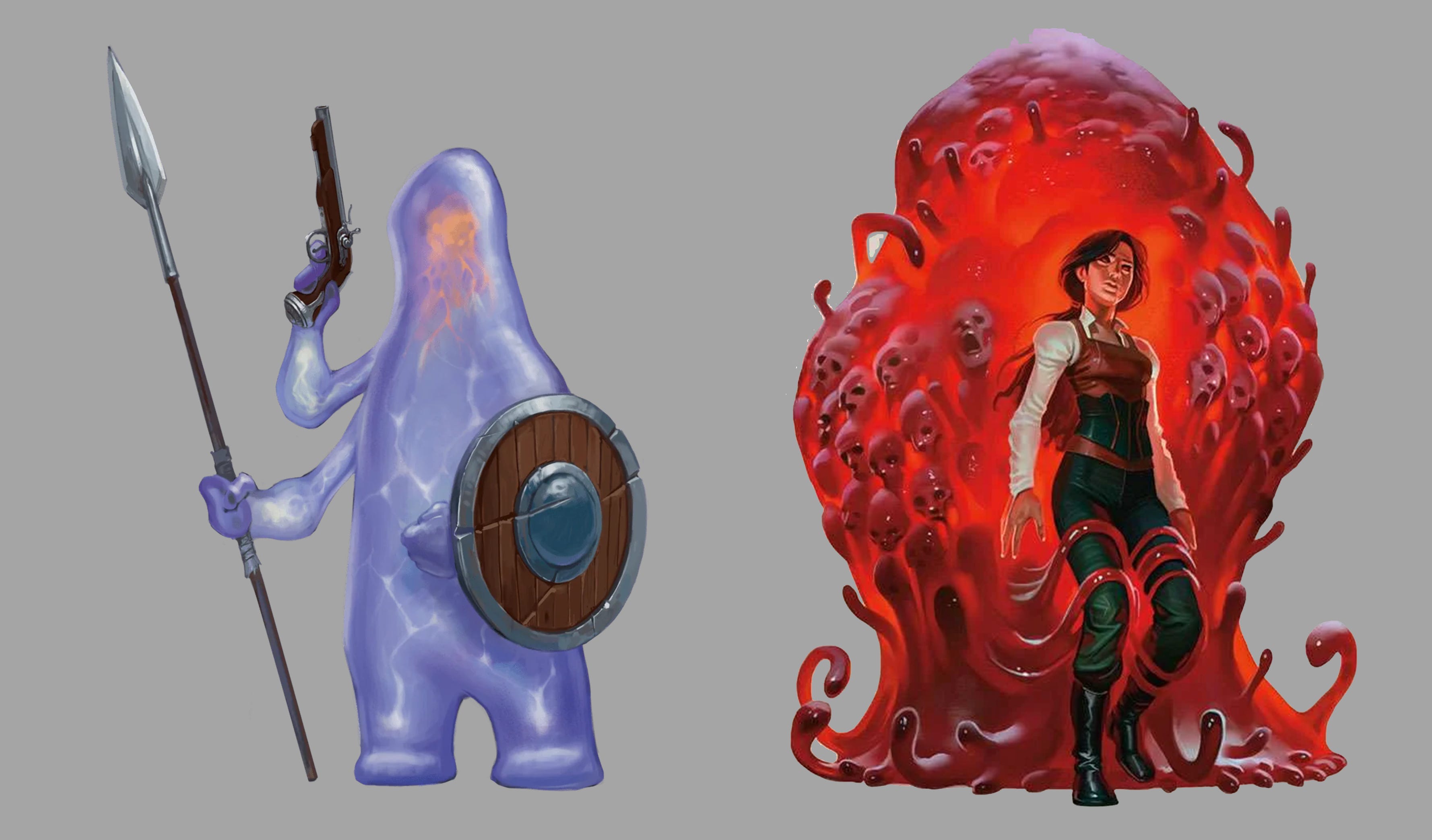
Spelljammer’s Plasmoids are a type of sentient ooze we actually get a fairly detailed description of, so we can be certain at least one type of ooze has a brain and nervous system. Memory eating Oblexes are similarly intelligent although it’s less clear if they have a distinct “brain” or if every part of them is involved in mental activity. They can “shed” parts of themselves to rid themselves of unwanted personalities and make a new oblex, so maybe a particular chuck somewhere corresponds to your recently devoured friend.
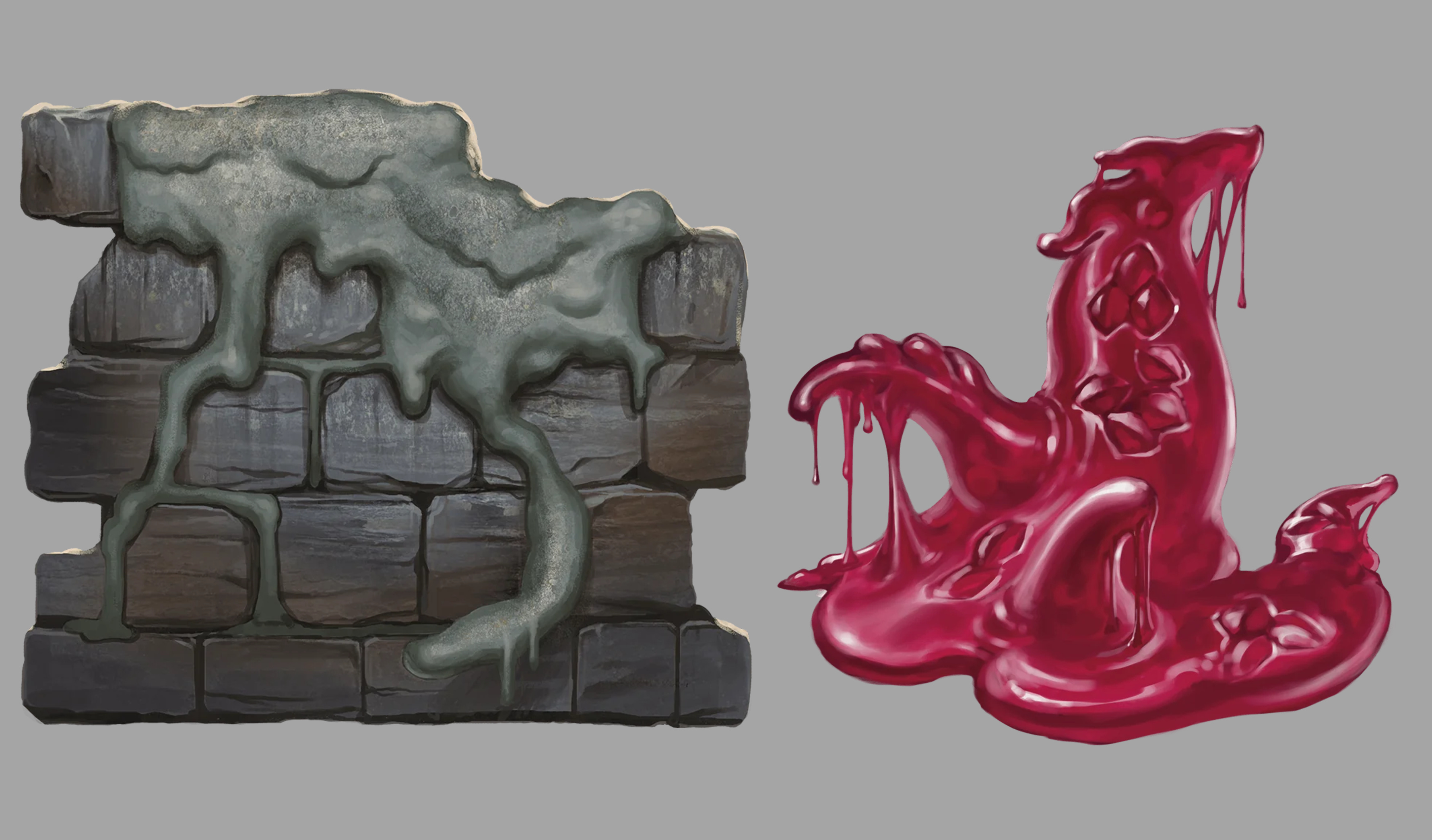
Grey Oozes and Dragonblood Oozes are the result of magical experiments gone wrong. The former from earth elemental summoning spells gone wrong (probably due to ethnic conflict in the mud hills again) and the later from, well it’s not actually clear what the dragonblood guys were hoping to accomplish. My point being it seems like oozes can also be elemental or magically-sustained lifeforms.
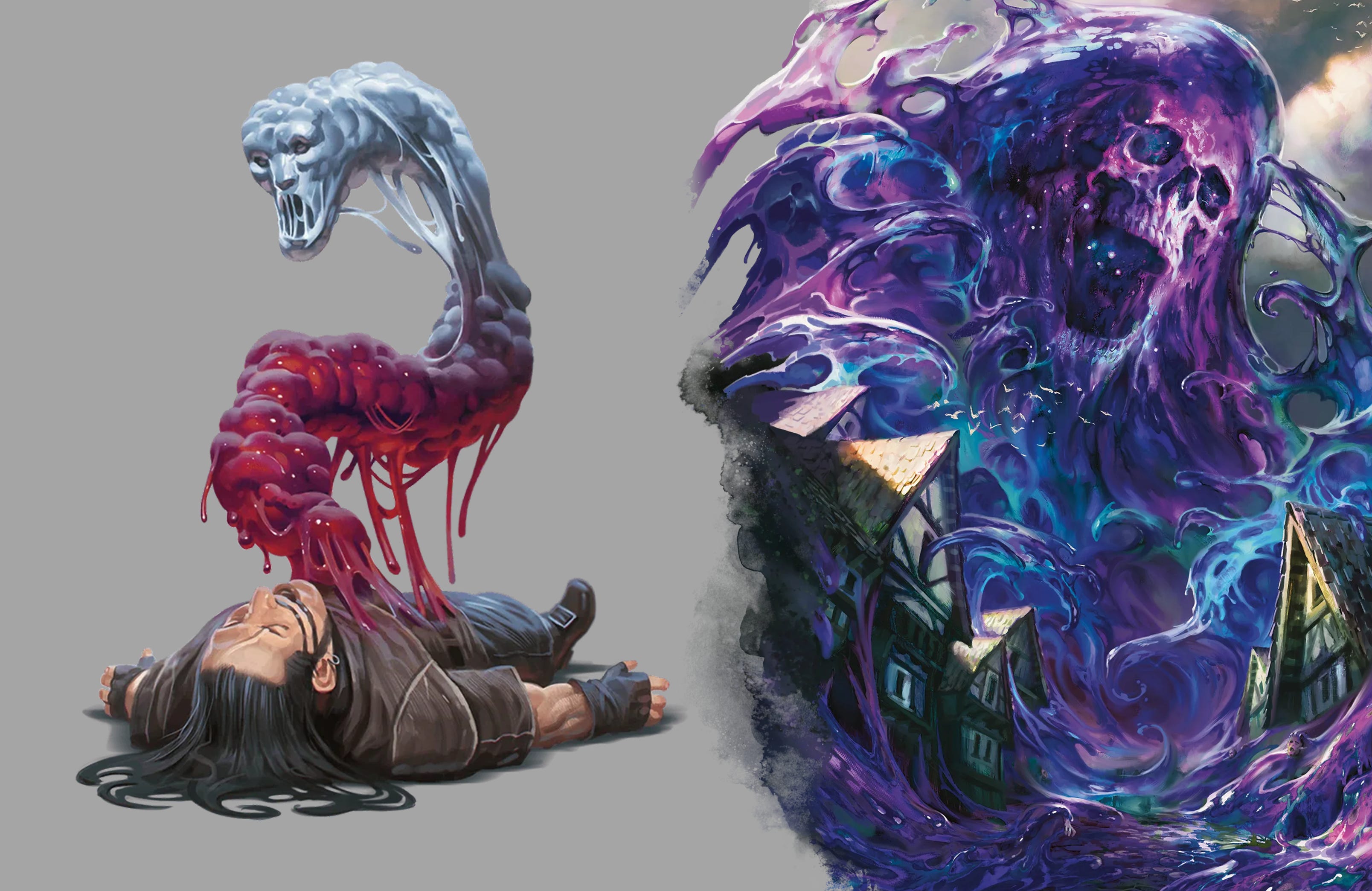
The Slithering Tracker is the result of a successful magical ritual to transfer a vengeful consciousness into a blob of bodily fluids. This ritual can only be done on willing participants. Why anyone would choose this CR 3 goo snake as their cursed vendetta-form and not say, vampirism, is a mystery to me. Maybe necromancers really hype up this one so they can keep your skeleton afterward? Maybe they don’t tell you that if you hate them that much you just die normally and become a CR 5 Revenant. The Blob of Annihilation is another corpse-derived ooze, this one from the bodies of dead gods. It could be a similar thing just on a larger scale. I think you could easily make the case that either of the former two are actually undead.
So that’s all the oozes.
Except it isn’t.
If it wasn’t already clear enough that ‘ooze’ is a nonsense category, I can also think of at least half a dozen monsters that could reasonably qualify for ooze status but aren’t classified as such.
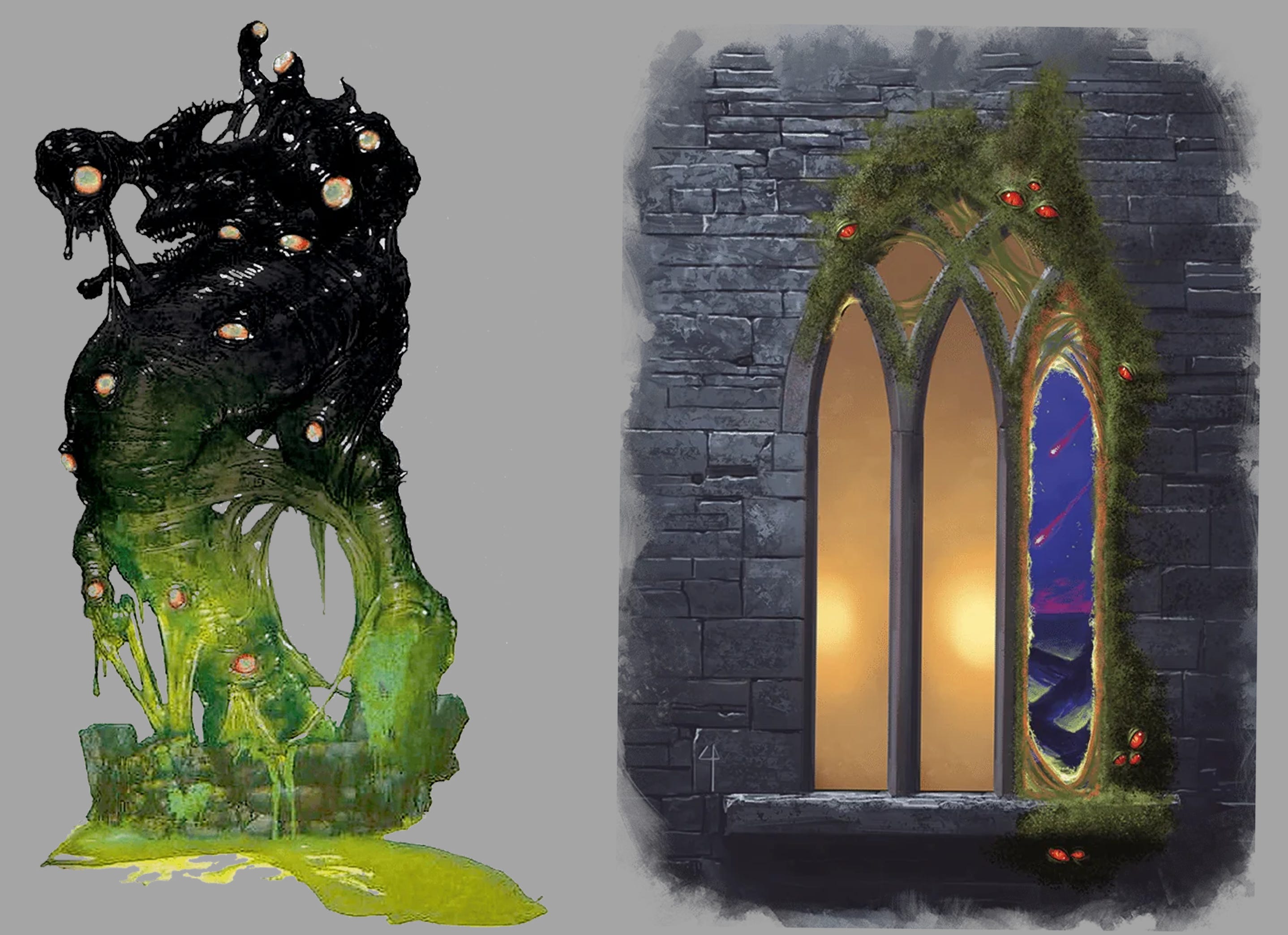
The first and most obvious absence is Juiblex, Demon Lord of Slimes and Oozes who might have classified himself as a demon to avoid responsibility for this whole mess. Official books give a vague non-committal nod towards the theory that Juiblex is the father of all oozes but given what we’ve seen so far this can’t be true. Maybe his title is more of an aspirational overreach. Jubilex’s only confirmed children are the Alkiliths, amorphous mold clumps that can turn into living portals to the abyss. They too are considered demons and not oozes.
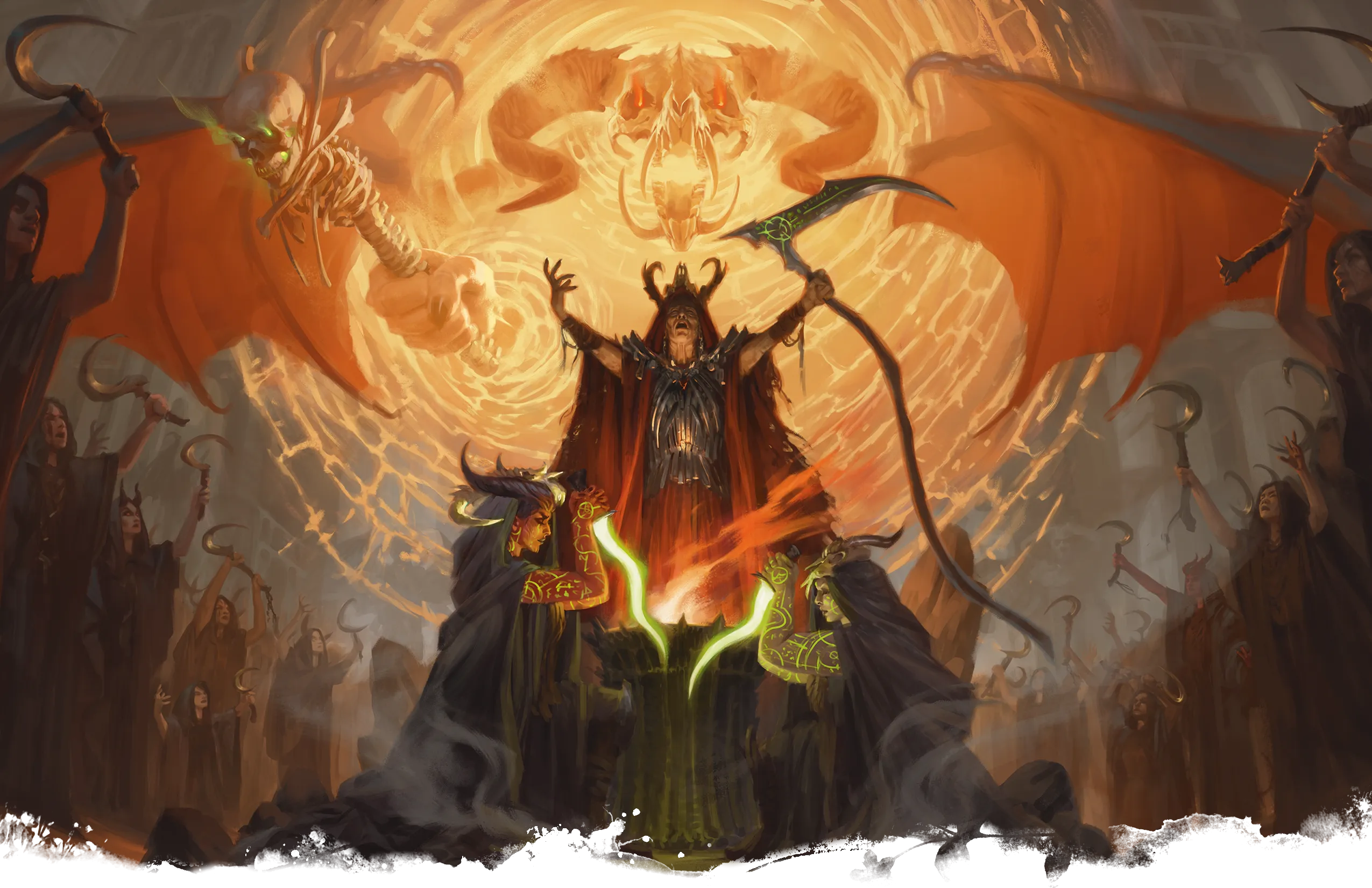
The faceless lord’s cultists might also qualify as oozes. He grants them various ooze powers in exchange for devotion before finally merging with them. So oozedom can also be a spectrum from fully human to part of the big blob himself. I shamefully missed these guys in my review of monster damage type resistances but their slimy organs trait gives them resistance to non-magical bludgeoning, piercing and slashing, which is a choice. Hey wait aren’t most organs already kinda slimy?

Well anyway I only missed these because they’re included as a list of possible modifiers to the cultist. Another easy to miss ooze is the Green Slime since it’s not actually listed as a monster but as a hazard, which is strange since it also has blindsight. The green slime grows on walls and ceilings. It kills its prey by dropping on them but is otherwise sessile. Which seems like a bit of a short sighted feeding strategy? How does it get back up on the wall? Are they just so slow no one notices them moving or is someone reapplying them to the ceiling?
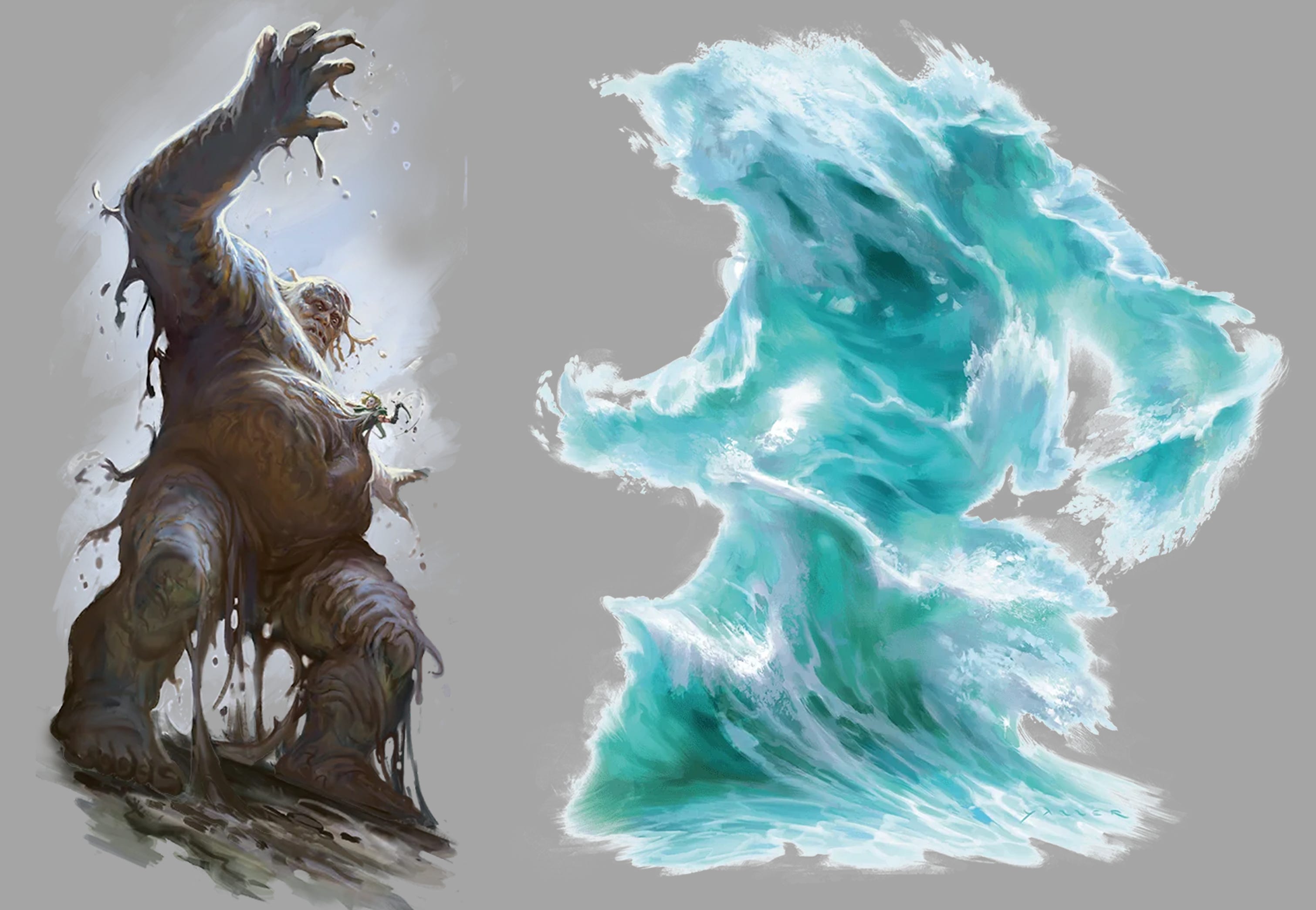
Lastly we have elementals. If indeed the gray ooze is a species of elemental then why not consider the Mud Hulk, A giant amorphous mud monster descended from hill giants. Sure it’s human shaped but so are the plasmoids. And if that qualifies then why not something with a lava-based body. Why not a Water Weird or a Water Elemental, is a certain level of viscosity a requirement?
To be clear, when I say oozes “aren’t real”, the blob monster currently digesting your face is very real, but taxonomically speaking the term “Ooze” is a misnomer. If the plant monster type, which includes both fungi and extraterrestrial mold-men, is anything to go by, oozes don’t need to be related to each other at all. “Ooze” could encompass various demons, elementals, slime molds, macroamoeboids, and blobs of magically animated matter. In fact, going by the above I think almost every ooze in D&D is a completely different type of organism.
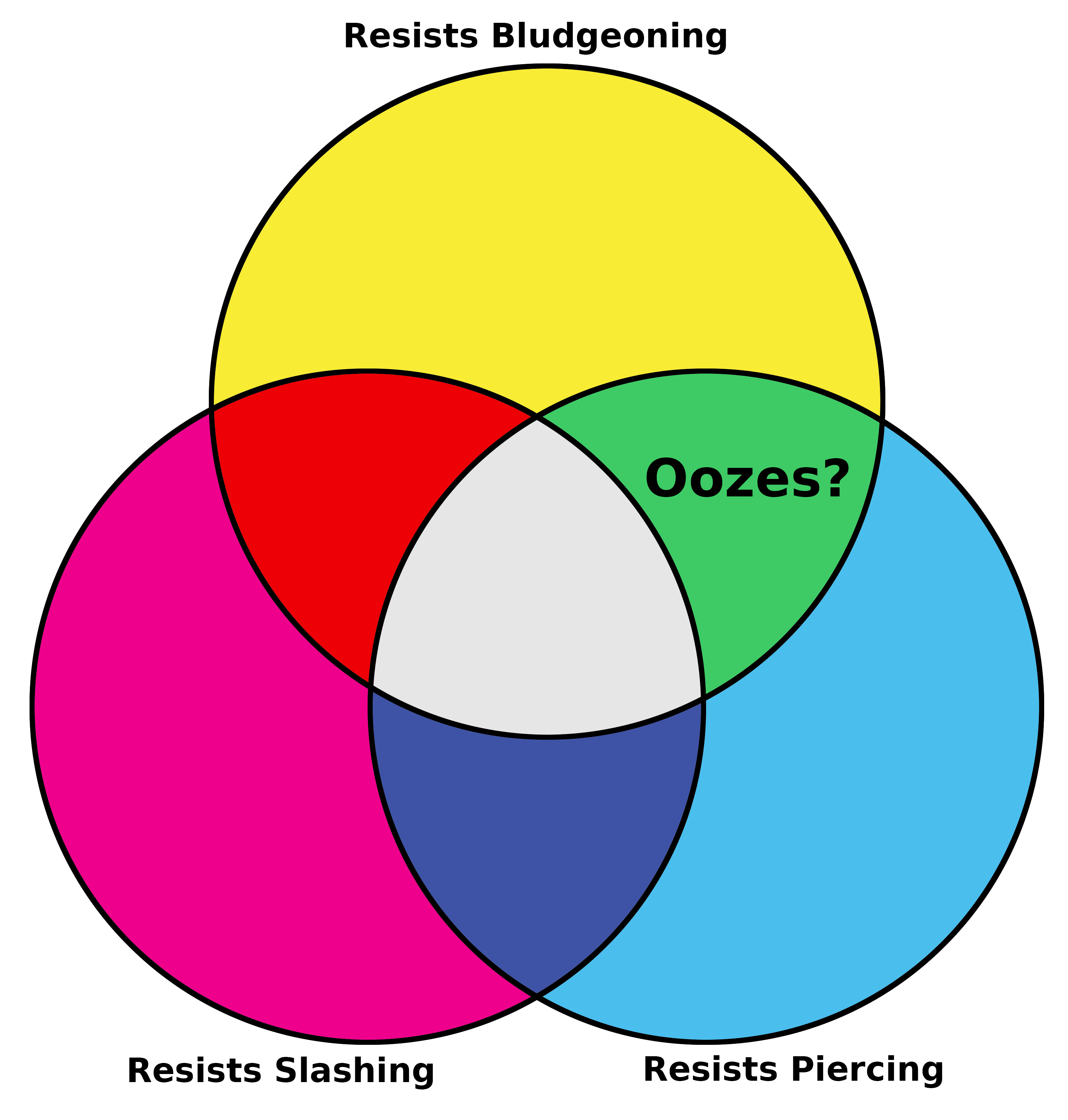
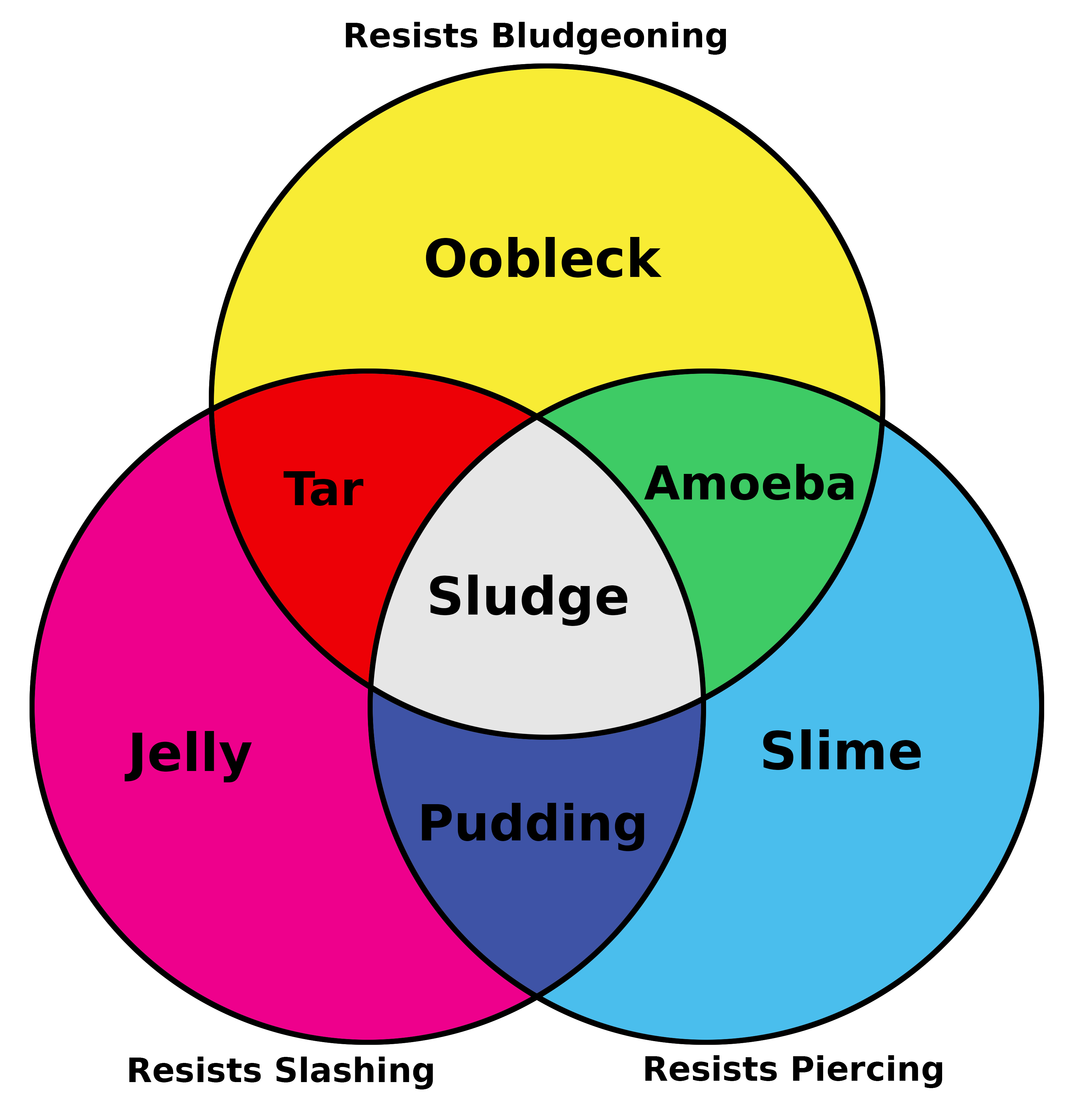
I really couldn’t tell you what an ooze is or what it’s made of, much less what weapon to reach for if you’re planning on fighting one. I can’t justify a spot for them on my diagram.
But maybe that’s okay.
Maybe the oozes don’t need a niche.
Maybe there’s enough diversity in the ooze family to fill every niche.
That is after all, what they’re good at.
I feel I should offer up the example of Sargent Schlock of "Schlock Mercenary" fame. Make of the following what you will:
Schlock is a "carbosilicate amorph", a being descended from what millions of years earlier had been self-sustaining nanite-based memory archives, which after their parent civilization went extinct gradually by selection evolved into intelligent life forms.
Physically Schlock resembles a five-foot high pile of greenish-brown dung, with eyes and usually manifested mouth for communication and arms for manipulation. Schlock has no organs other than his eyes (which are actually symbionts– long story). His entire body is responsive to hearing/touch and taste/smell His intelligence and personality are distributed, so that physical destruction of part of his mass is equivalent to brain damage. His nanite components have no intelligence other than an instinctive tropism to reunite with any nearby pieces of himself, and to respond to the directions of the overall intelligence. Despite being amorphous he can exert considerable mechanical force and can move very quickly.
Schlock can be temporarily disabled by being blasted apart into chunks, which can't manifest his gestalt self until they reunite. He's temperature sensitive enough that being deep-frozen will kill him (happened once but thanks to personality archiving he got resurrected). He can assimilate almost any organic matter although oddly enough he has personal favorites with regards to food, and in fact he's virtually a crawling intelligent chemical factory.